

Starting a chat
Click New chat in the sidebar. You’ll land on What are we creating today? with a message box and a row of starters.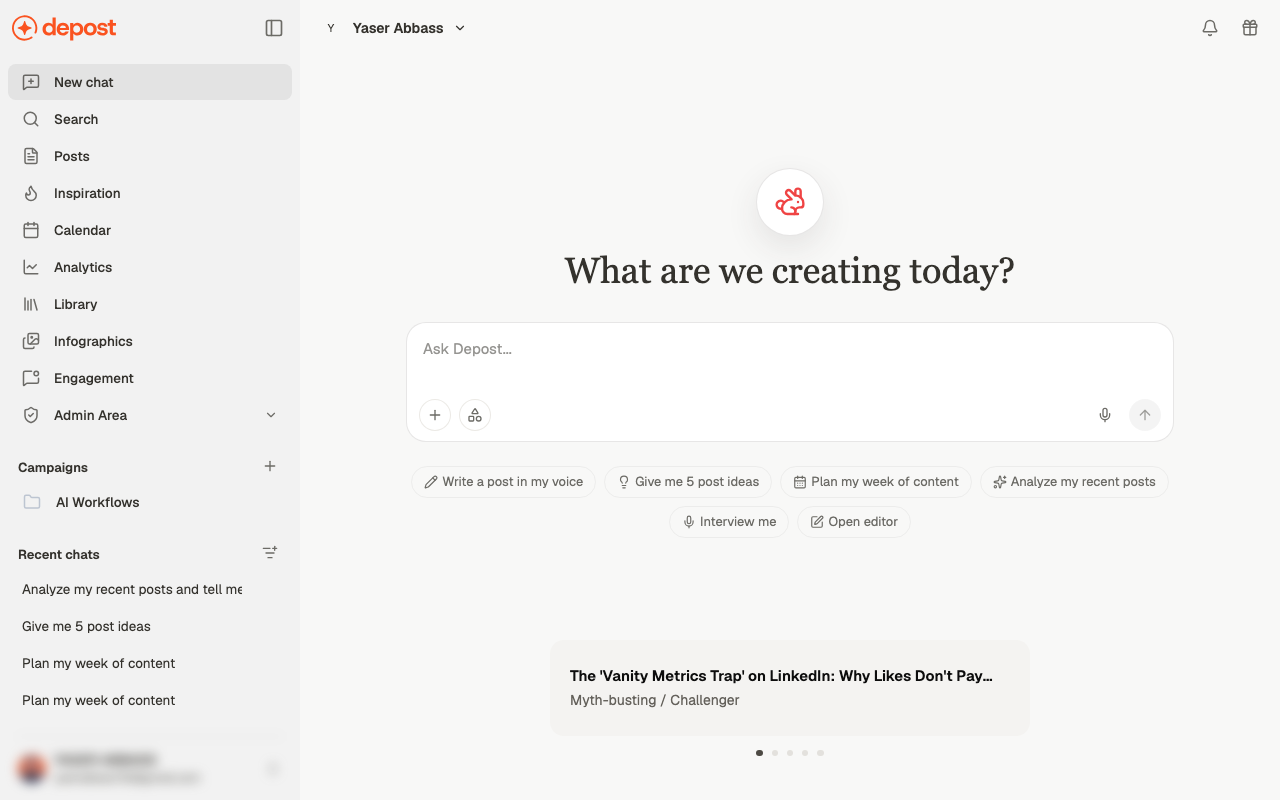
Write a post in my voice
Best used with a topic added — on its own it offers ideas to choose from rather than a
draft. See Create a post.
Give me 5 post ideas
Ideas grounded in your brand and history, not generic prompts.
Plan my week of content
A weekly plan you can turn into scheduled posts.
Analyze my recent posts
A read on your own content before you write anything new.
This week’s ideas
Below the composer, a card cycles through five post ideas prepared for you — generated when your brand was first analyzed, and refreshed weekly. Each shows a title and the angle it takes, such as Proof / Case Study.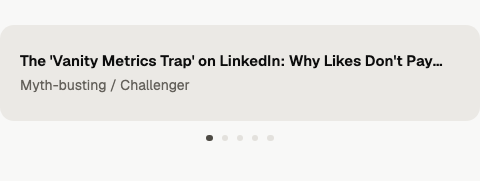
- Hover to pause the rotation while you read
- Click a card, or a dot, to stop it cycling and jump to that idea
- Clicking a card fills the message box with it, so you can edit the wording before sending rather than committing to it as written
What you can ask for
You don’t need to learn a menu. Ask in your own words and Depost AI picks the right action. Broadly, it can:Analyze
Analyze
Audit your profile, review recent or best-performing posts, find content gaps, study
your voice patterns, or explain what your performance data means. See
Analyze your content, or Find what’s trending for the
outward-facing half.
Find ideas
Find ideas
Post ideas, fresh or contrarian angles, and concepts for lead magnets, carousels, and
infographics. See Get ideas and angles.
Create
Create
Full posts, hooks, CTAs, pinned comments, post series, video scripts, lead magnet
outlines, carousel and infographic content.
Repurpose
Repurpose
Turn a post into a carousel, an infographic, a lead magnet, or a video script — and
back the other way. One idea can become a pack of several formats at once.
Improve
Improve
Rewrite, sharpen the hook, strengthen the CTA, improve readability or structure,
humanize, shorten, add proof, apply your brand voice, change tone, or make it less
salesy.
Plan and set strategy
Plan and set strategy
Weekly and monthly plans, launch campaigns, lead magnet promotion — plus reviewing and
updating the strategy profile that shapes everything else.
From chat to a post
When a draft is close, move it into the editor rather than re-prompting the chat repeatedly. The editor is where you format, add media, get review, and schedule. A chat can also stay attached to a post. When it is, a set of one-click actions appears above the message box — rewrite, sharpen, improve the hook, and so on — so you can keep refining without typing the instruction each time.Related
Give chat the right context
Choose which of your material Depost AI draws on — and see what it always uses.
Attachments and voice input
Bring files, library documents, and spoken notes into a chat.
Organize chats and campaigns
Favorites, campaigns, archiving, and finding old threads.
Posts and editor
Take a draft through editing, review, and publishing.