

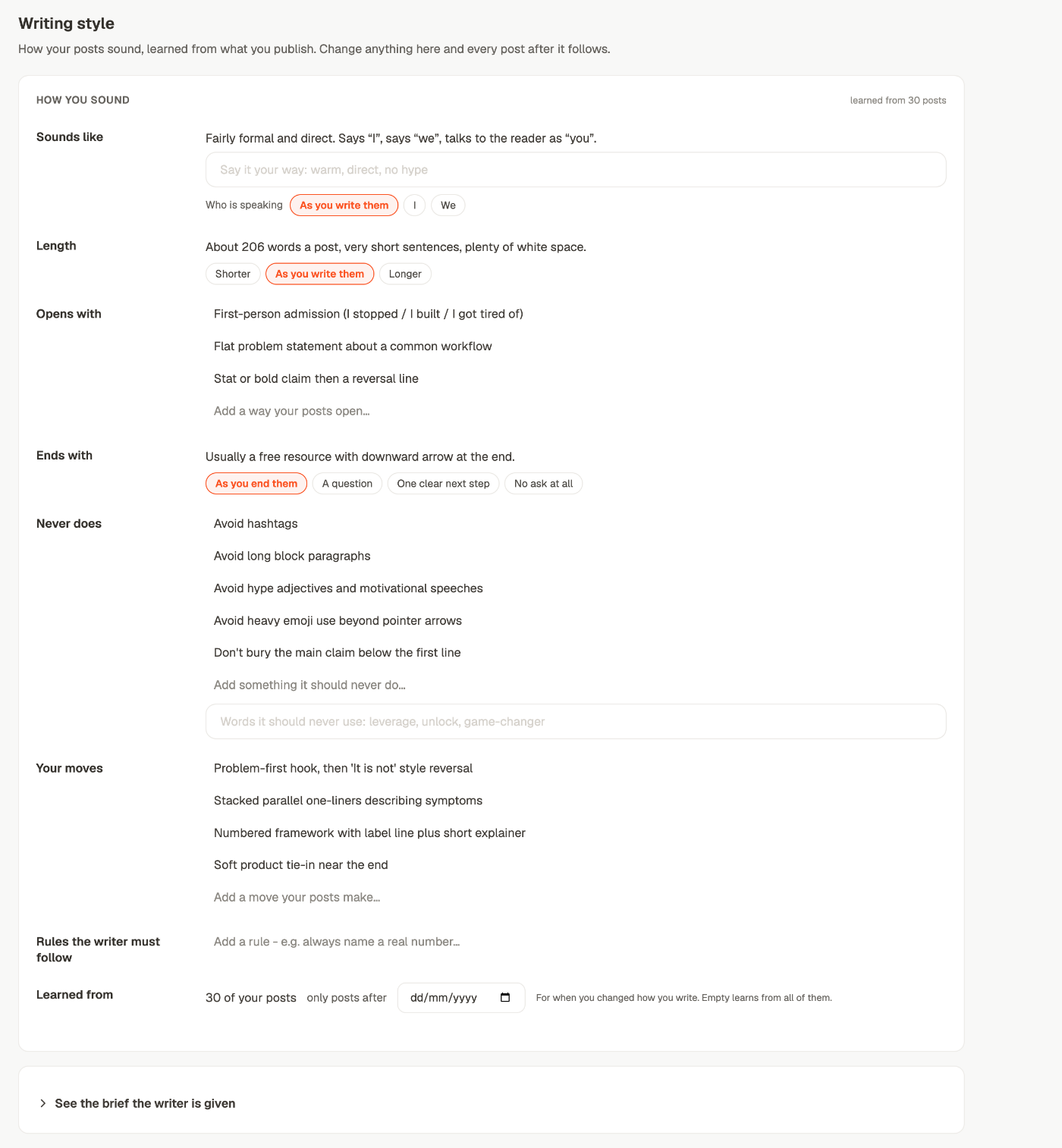
How to read a row
Each row has two parts, and the order is deliberate:- The grey line at the top — what Depost AI read in your posts. “About 206 words a post, very short sentences, plenty of white space.”
- Your setting underneath — what you want instead, if anything.
The rows
Lines you changed, and getting back
Change a line and the row picks up a yours tag. A Back to what was learned link appears with it, so an experiment is never one-way — you can always return the row to what your posts actually say.Rules the writer must follow
This row is worth more attention than its size suggests. Everything else on the screen describes how you write; this one is an instruction, and the writer is held to it. Good rules are checkable:- Always name a real number rather than “many” or “most”
- Never open with a question
- Keep paragraphs to two lines
When a change takes effect
Saving says Saved. Your next post uses this. That’s exact: the next post, not the one already in your editor and not anything already scheduled. To apply a change to a draft you already have, ask chat to rewrite it.It keeps learning, and your changes survive
Your voice is re-read from your posts on a weekly cycle, so it follows you rather than freezing on the month you signed up.A refresh never undoes your changes. What you set by hand is stored separately and
re-applied on top of every refresh. So the learned reading can move as your writing moves,
while never open with a question stays true indefinitely.
Strategy is a decision, so it waits for you. Style is an observation, so it updates — and
your decisions about it are kept apart precisely so it can.
See the brief the writer is given
At the bottom of the screen, folded away, is the actual brief every draft is written against: what was learned from your posts, with your changes applied on top. Open it when output doesn’t sound like you and you can’t tell why. It’s the difference between guessing at what the writer was told and reading it.The same card, in two other places
This isn’t the only way in. The same rows, saving to the same place:- In chat, as the “Sound right?” card after a draft.
- During setup, under your first post, with a Rewrite this post with it button.
When it still doesn’t sound like you
1
Add a rule for the specific thing
The most direct fix. One line in Rules the writer must follow beats five attempts at
rephrasing a prompt.
2
Check the strategy, not the style
A vague audience produces vague writing that no voice setting can rescue. See
your strategy.
3
Narrow what chat is reading
Viral Posts in particular pulls drafts toward other people’s structures. See
give chat the right context.
4
Read the brief
If the first three didn’t do it, the brief tells you what the writer was actually
working from.
Related
Your strategy
What posts are about, and who they’re for.
Your brand voice in chat
Standing instructions and reviews, in conversation.
Improve a draft
Fixing one post rather than the rule.
Create a post
Where all of this shows up.