> ## Documentation Index
> Fetch the complete documentation index at: https://docs.depost.ai/llms.txt
> Use this file to discover all available pages before exploring further.
# Your strategy
> The five things every idea, plan and post is built from — where each one came from, and how to change it.
Everything Depost AI writes is aimed at something: a reader, a set of topics, and a thing you
want back. That's your **strategy**, and it has its own screen.
**Settings → Personal brand → Strategy.** Every row saves as you change it — there's no save
button, and nothing is pending.
This is the single highest-leverage screen in the product. A wrong audience or a wrong
offer isn't an error you'll see; it's every draft being quietly aimed at the wrong person.
Ten minutes here is worth more than any prompt you'll write this month.
## Where it came from
You didn't fill this in. It was read for you, from three things:
| Source | What it gave |
| - | - |
| **Your posts** | The topics you actually publish about, who engages, what you keep coming back to |
| **Your LinkedIn profile** | What you do and who you say you do it for |
| **Anything you typed at signup** | The optional context box — what you do *now*, and what you want LinkedIn to do for you |
That last one matters more than it looks. Your posts say what you have done; the context box
says what you're doing now, and where the two disagree, Depost AI follows you. See
[set up your account](/started/set-up).
## 1. Who you write for
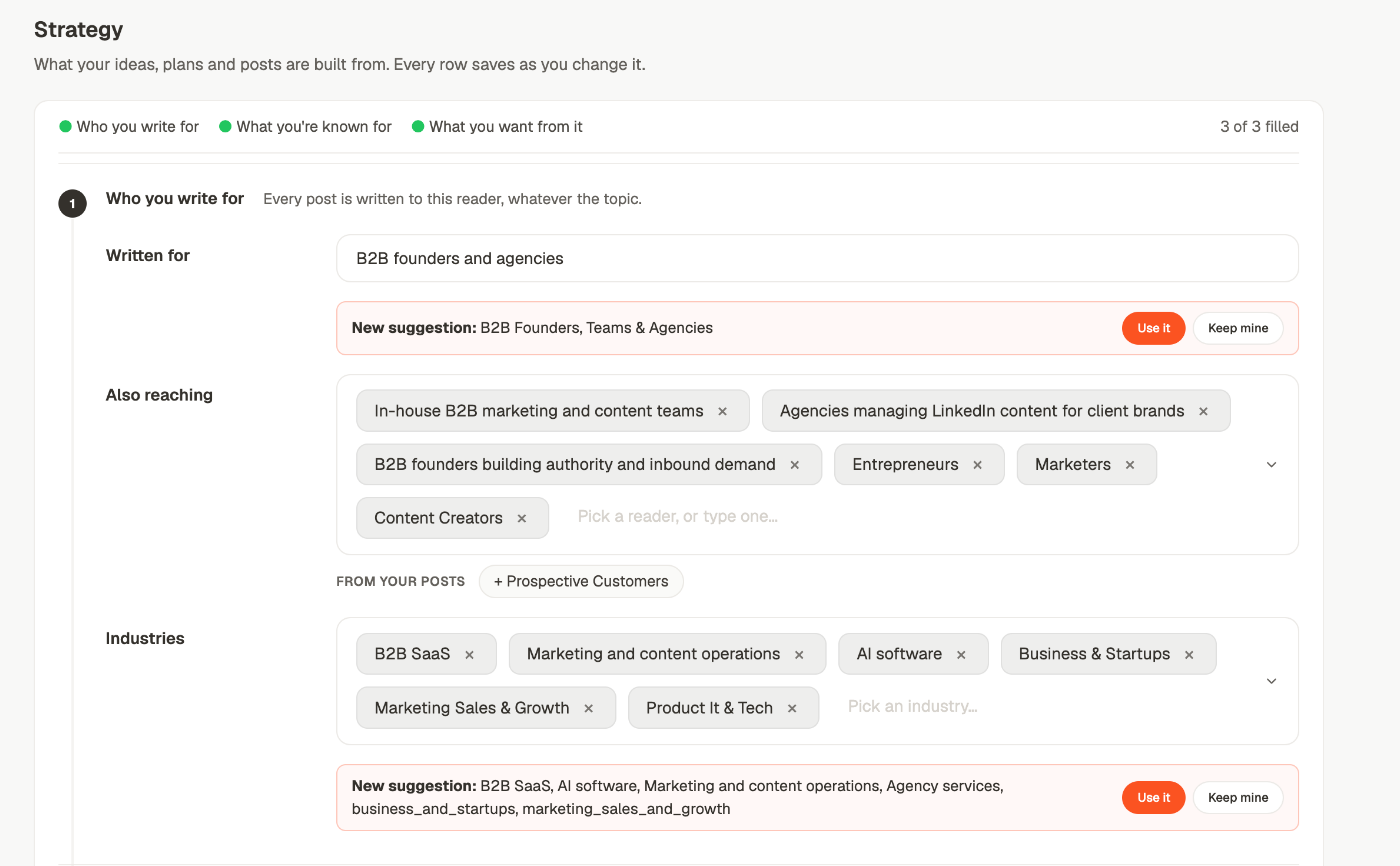 **Every post is written to this reader, whatever the topic.**
| Row | What it is |
| - | - |
| **Written for** | One reader. The post is addressed to them |
| **Also reaching** | Everyone else who should recognise themselves |
| **Industries** | The fields you're read in |
Be narrower than feels comfortable in **Written for**. "B2B founders" describes millions
of people, so it produces writing that could be addressed to anyone. "Technical founders
making their first marketing hire" produces specifics, because there are specifics to say.
Everyone else you still want goes in **Also reaching** — that's what the row is for.
## 2. What you're known for
**Every post is written to this reader, whatever the topic.**
| Row | What it is |
| - | - |
| **Written for** | One reader. The post is addressed to them |
| **Also reaching** | Everyone else who should recognise themselves |
| **Industries** | The fields you're read in |
Be narrower than feels comfortable in **Written for**. "B2B founders" describes millions
of people, so it produces writing that could be addressed to anyone. "Technical founders
making their first marketing hire" produces specifics, because there are specifics to say.
Everyone else you still want goes in **Also reaching** — that's what the row is for.
## 2. What you're known for
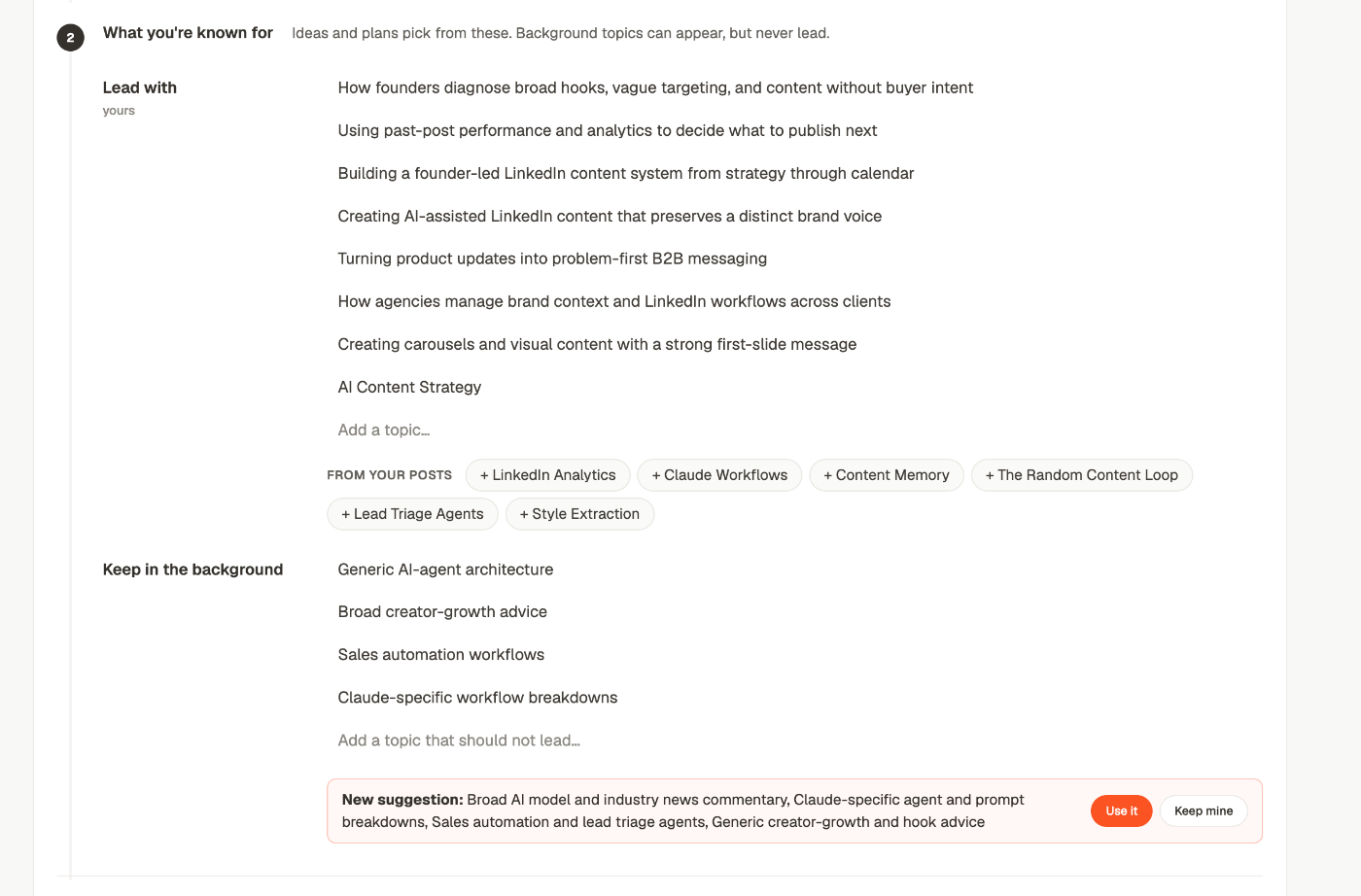 **Ideas and plans pick from these. Background topics can appear, but never lead.**
* **Lead with** — what an idea is allowed to be about.
* **Keep in the background** — what can show up as supporting material but never be the
point of a post.
The second list is the one people skip, and it's the one that fixes the most. If your
best-performing post is about something you don't sell, that topic belongs in the
background: it will keep earning engagement and keep pulling your audience somewhere you
can't follow up.
## 3. What you want from it
**Ideas and plans pick from these. Background topics can appear, but never lead.**
* **Lead with** — what an idea is allowed to be about.
* **Keep in the background** — what can show up as supporting material but never be the
point of a post.
The second list is the one people skip, and it's the one that fixes the most. If your
best-performing post is about something you don't sell, that topic belongs in the
background: it will keep earning engagement and keep pulling your audience somewhere you
can't follow up.
## 3. What you want from it
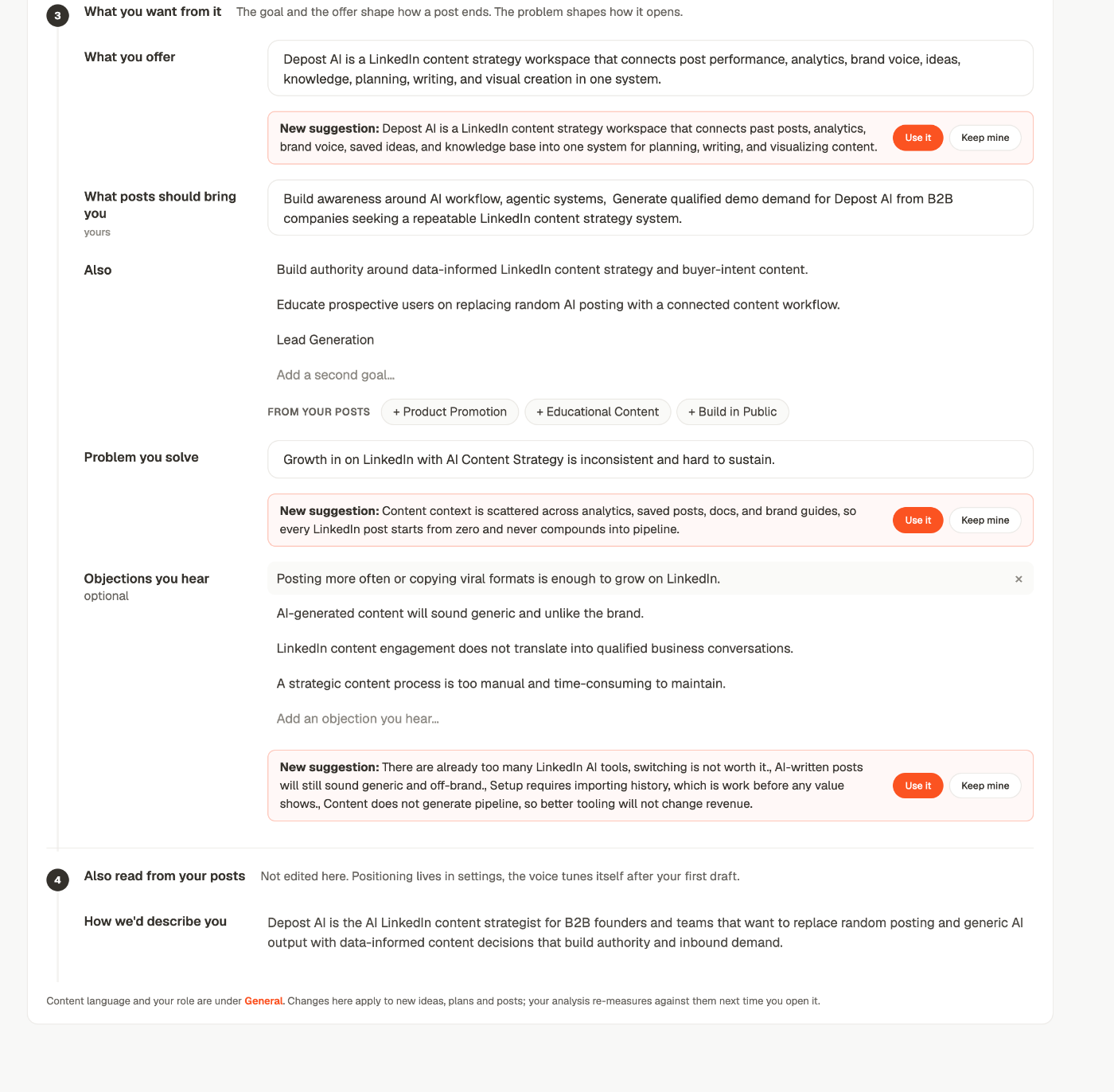 **The goal and the offer shape how a post ends. The problem shapes how it opens.**
| Row | What it changes |
| - | - |
| **What you offer** | What a post can mention without lurching into a pitch |
| **What posts should bring you** | The one thing a post is for. Pick one — four equal goals is none |
| **Also** | Secondary goals. These add range, they don't compete |
| **Problem you solve** | The opening. A post that starts on a real problem doesn't need a hook trick |
| **Objections you hear** | Optional, and underused. What a reader thinks that stops them acting |
Objections are worth filling in by hand. They're the hardest thing to read off your posts —
you rarely write down what people say to you in DMs — and they're what turns a post from a
statement into an argument.
## 4. How we'd describe you
The last block isn't editable here. It's how Depost AI would introduce you in a sentence,
read from your posts and profile — a check on whether the rest of the screen is pointed at
the right person.
The line underneath says where the two settings that aren't on this screen live: **content
language** and **your role** are under **General**.
## Three ways a row changes
### You type it
Click into a row and change it. It saves as you go, and the row picks up a small **yours**
tag — that's Depost AI marking that the value is yours rather than something it read.
### A chip from your posts
Under the list rows sits **FROM YOUR POSTS** and a row of `+` chips. Those are things the
analysis actually found in your published posts that aren't on the row yet. One click adds
one.
Use them as a reality check as much as a shortcut: a topic you publish constantly that
isn't in **Lead with** is either a gap in the strategy or a habit worth dropping.
### A suggestion from a later read
This is the part worth understanding properly.
Depost AI re-reads your posts periodically. **A re-read never changes a row.** It leaves a
suggestion under the row instead:
> **New suggestion:** B2B Founders, Teams & Agencies `Use it` `Keep mine`
Four rules govern those, and together they're the whole behaviour:
Your stored value stays exactly as it is until you answer. A Monday can't rewrite what
you set up on Friday.
A row you've already answered or edited is left alone — permanently. It won't come back
next month with a different idea.
**Use it** writes the suggestion in. **Keep mine** writes back what's already there.
Either one counts as an answer, so you stop being asked about that row.
They don't pile up. What you see is what the most recent read thinks.
**Keep mine** is a real answer, not a dismissal. Use it when the value is right — that's
what makes the asking stop. If you ignore the row instead, the next read will raise it
again.
## What changes when you change it
Changes apply to **new** ideas, plans and posts. A draft already written doesn't rewrite
itself, and neither does anything scheduled.
Your analysis re-measures against the new strategy the next time you open it — which is
usually the point. Fixing your topic list and then looking at
[analytics](/analytics/overview) tells you something different from looking at it before.
## Changing it from chat instead
Chat reads and writes the same strategy, so use whichever is closer to hand:
| Ask | What happens |
| - | - |
| *"show me my current strategy"* | Reads it back |
| *"review my strategy"* | Proposes a replacement — **not saved** until you say *"apply that"* |
| *"update my audience to…"* | Changes that row |
Full detail, including why a review waits: [your content strategy](/chat/strategy).
## When to come back to it
Not one bad draft — a pattern. If three posts in a row are aimed at the wrong reader,
that's this screen, not your prompts. Fighting it prompt by prompt means re-fixing the
same fault every time.
A new offer changes how every post should end. This is the first thing to update, and
the one most people forget until the drafts start reading oddly.
It means a later read of your posts disagrees with a row. Worth thirty seconds — it's
usually the product noticing a drift before you have.
## Related
The other half: not what you write about, but how it sounds.
Reading and changing it in conversation.
The first thing the strategy decides.
Where the first version of this came from.
This documentation is built and hosted on [Mintlify](https://mintlify.com), a developer documentation platform.
**The goal and the offer shape how a post ends. The problem shapes how it opens.**
| Row | What it changes |
| - | - |
| **What you offer** | What a post can mention without lurching into a pitch |
| **What posts should bring you** | The one thing a post is for. Pick one — four equal goals is none |
| **Also** | Secondary goals. These add range, they don't compete |
| **Problem you solve** | The opening. A post that starts on a real problem doesn't need a hook trick |
| **Objections you hear** | Optional, and underused. What a reader thinks that stops them acting |
Objections are worth filling in by hand. They're the hardest thing to read off your posts —
you rarely write down what people say to you in DMs — and they're what turns a post from a
statement into an argument.
## 4. How we'd describe you
The last block isn't editable here. It's how Depost AI would introduce you in a sentence,
read from your posts and profile — a check on whether the rest of the screen is pointed at
the right person.
The line underneath says where the two settings that aren't on this screen live: **content
language** and **your role** are under **General**.
## Three ways a row changes
### You type it
Click into a row and change it. It saves as you go, and the row picks up a small **yours**
tag — that's Depost AI marking that the value is yours rather than something it read.
### A chip from your posts
Under the list rows sits **FROM YOUR POSTS** and a row of `+` chips. Those are things the
analysis actually found in your published posts that aren't on the row yet. One click adds
one.
Use them as a reality check as much as a shortcut: a topic you publish constantly that
isn't in **Lead with** is either a gap in the strategy or a habit worth dropping.
### A suggestion from a later read
This is the part worth understanding properly.
Depost AI re-reads your posts periodically. **A re-read never changes a row.** It leaves a
suggestion under the row instead:
> **New suggestion:** B2B Founders, Teams & Agencies `Use it` `Keep mine`
Four rules govern those, and together they're the whole behaviour:
Your stored value stays exactly as it is until you answer. A Monday can't rewrite what
you set up on Friday.
A row you've already answered or edited is left alone — permanently. It won't come back
next month with a different idea.
**Use it** writes the suggestion in. **Keep mine** writes back what's already there.
Either one counts as an answer, so you stop being asked about that row.
They don't pile up. What you see is what the most recent read thinks.
**Keep mine** is a real answer, not a dismissal. Use it when the value is right — that's
what makes the asking stop. If you ignore the row instead, the next read will raise it
again.
## What changes when you change it
Changes apply to **new** ideas, plans and posts. A draft already written doesn't rewrite
itself, and neither does anything scheduled.
Your analysis re-measures against the new strategy the next time you open it — which is
usually the point. Fixing your topic list and then looking at
[analytics](/analytics/overview) tells you something different from looking at it before.
## Changing it from chat instead
Chat reads and writes the same strategy, so use whichever is closer to hand:
| Ask | What happens |
| - | - |
| *"show me my current strategy"* | Reads it back |
| *"review my strategy"* | Proposes a replacement — **not saved** until you say *"apply that"* |
| *"update my audience to…"* | Changes that row |
Full detail, including why a review waits: [your content strategy](/chat/strategy).
## When to come back to it
Not one bad draft — a pattern. If three posts in a row are aimed at the wrong reader,
that's this screen, not your prompts. Fighting it prompt by prompt means re-fixing the
same fault every time.
A new offer changes how every post should end. This is the first thing to update, and
the one most people forget until the drafts start reading oddly.
It means a later read of your posts disagrees with a row. Worth thirty seconds — it's
usually the product noticing a drift before you have.
## Related
The other half: not what you write about, but how it sounds.
Reading and changing it in conversation.
The first thing the strategy decides.
Where the first version of this came from.
This documentation is built and hosted on [Mintlify](https://mintlify.com), a developer documentation platform.